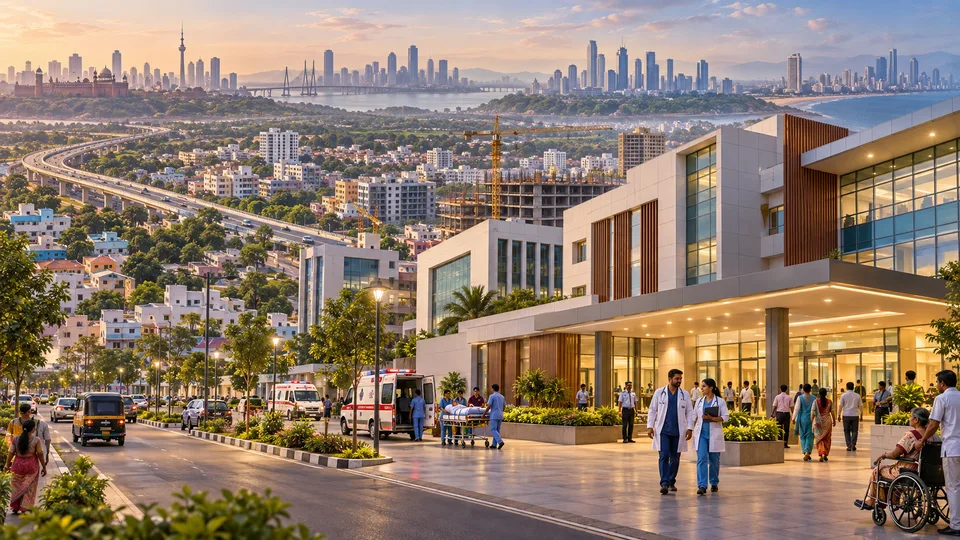
For decades, India’s best hospitals clustered in a handful of metros — Delhi, Mumbai, Bengaluru, and Chennai — leaving smaller cities to rely on referrals for anything beyond routine care. That pattern is now reversing. Tier 2 and Tier 3 markets have become the fastest-growing segment of the country’s medical sector, expanding at roughly 18% a year, faster than the metros they once depended on.
The shift is driven by necessity as much as opportunity. Smaller cities currently have just 0.8 to 1.2 hospital beds per 1,000 people, against 2.7 to 3.0 in major metros — a gap that leaves millions without nearby access to serious care. Rising incomes, growing health insurance penetration, and improving road and digital connectivity have made it commercially viable to close that gap, and large chains are responding.
This expansion matters beyond convenience. It cuts the cost and physical strain of long-distance travel for patients, decongests overloaded metro hospitals, and brings emergency and maternal care closer to where people actually live.
The challenges are real, though. Advanced ICUs, cancer radiation units, and super-specialists remain scarce outside the major hubs, so patients needing complex treatment often still travel to metro hospitals rather than rely on local equipment. Staffing is a persistent constraint too — specialists are reluctant to relocate without matching infrastructure, training pipelines, and patient volumes. And new hospitals in these markets are largely building digital systems and operations from scratch, without the legacy tech or established referral networks metro chains have built up over years.
Even so, the direction is clear. As investment continues to flow into India’s smaller cities, they are becoming the next major frontier for the country’s healthcare growth.