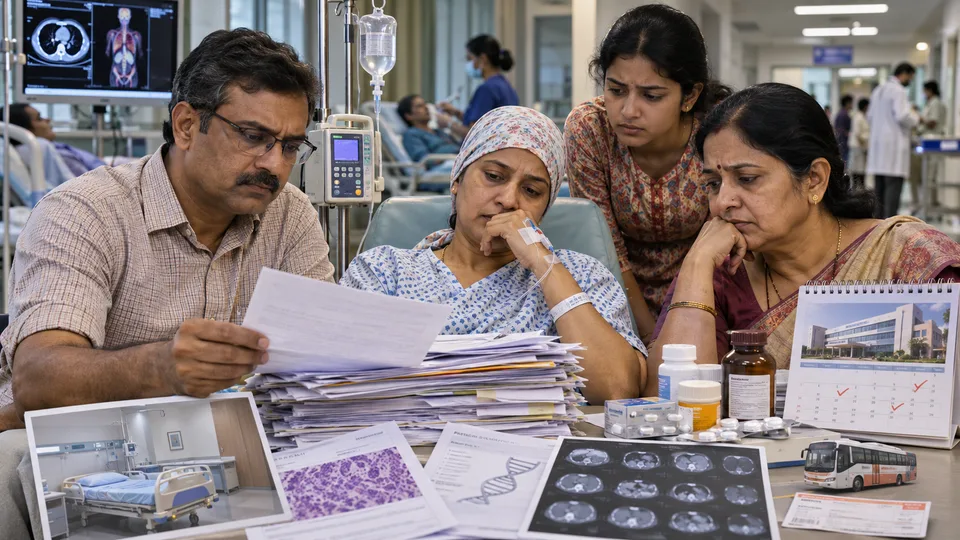
The government is regulating cancer drug prices, but the bill that drives families into debt is rarely the drug alone. Oncologists say affordability has to be measured across the whole pathway of care.
Cancer care in India is getting more affordable on paper, with the government stepping in to regulate the prices of cancer medicines. But the bill that pushes families into debt includes imaging, molecular tests, hospital stays, supportive care and months of follow-up. India reported about 1.41 million new cancer cases and 917,000 deaths in 2022, according to GLOBOCAN, so what makes treatment truly affordable matters. Doctors across specialities say the answer lies in looking beyond the price of a single drug.
Where the costs begin
For most families, the expense starts before cancer is even named. Dr Bibhu Anand, a medicine specialist at Sir Ganga Ram Hospital, says, “By the time a patient reaches an oncologist, the family has often already spent weeks and a considerable sum on consultations, scans and blood tests, sometimes repeated at different places. As the first point of contact, we have a responsibility to investigate sensibly, avoid duplication, and refer early to the right specialist. A delay of even a few weeks can mean more advanced disease, and more advanced disease means more expensive treatment.”
The bill behind the bill
Dr Adwaita Anant Gore, Senior Consultant in Medical Oncology at SSO Cancer Hospitals, says the real damage often lies elsewhere. “While the higher drug prices attract headlines, a medical crisis triggers a multi-front financial erosion that turns a temporary illness into a household bankruptcy.”
Dr. Chirag Bhirud, Consultant Surgical Oncologist at Dr. Chirag Cancer Care’s Clinic, Pune, describes what that erosion looks like. “A patient may require multiple scans, biopsies, molecular tests, supportive medicines, nutritional care and management of treatment-related complications. For families travelling from smaller towns, transport, accommodation and loss of income add another layer of expense.”
The strain builds over time. “In my experience, the greater challenge is often not starting treatment but continuing it. Families may manage the initial surgery or chemotherapy but struggle financially when treatment extends over several months. Some patients postpone investigations or follow-up visits because their savings are exhausted.”
His remedy starts with honesty at the outset. “Hospitals should provide realistic cost estimates, including possible additional expenses, before treatment begins.”
Where price caps stop
Price regulation has worked best for older drugs. “Government price regulation has helped make several essential cancer medicines more affordable,” says Dr Deepak Jha, Chief of Surgical Oncology and Breast Surgery at Artemis Hospital, Gurugram. “However, many newer targeted therapies and immunotherapies remain beyond the financial reach of ordinary families, particularly when treatment must continue for several months or years.”
Dr Amol Akhade, Consultant in Medical Oncology at Fortis Hospital Mulund, Mumbai, makes the same point. “Price caps are useful, but they cannot solve the entire affordability problem. Patients needing patented or imported therapies often remain exposed to high costs.” He argues for a wider strategy: “We need a broader approach: faster access to quality-assured biosimilars, local research and manufacturing, transparent pricing, insurance coverage and patient-access programmes.”
Dr Jha adds that the costliest option is not always the right one. “The latest medicine is not necessarily the most appropriate medicine for every patient.”
Immunotherapy: promise, with caution
Immunotherapy has changed cancer treatment, but it has limits. Dr Jha says it “cannot replace chemotherapy, radiation and surgery completely. They work differently and can complement each other.”
India is also researching whether lower doses could cut costs. Dr Bhawana S Awasthy, Director of Medical Oncology at CK Birla Hospital, Gurugram, calls it “an encouraging area of research, particularly in India, where affordability and accessibility remain significant concerns.” She is clear about what is not yet known. “However, these findings should be interpreted cautiously and cannot yet establish lower doses as a universal alternative to standard protocols.”
Her warning to clinicians is direct. “Doctors should never independently reduce doses or alter treatment schedules outside validated clinical protocols.”
Dr Jha adds that a cheaper dose does not make the whole bill cheap. “Decreasing the dose may reduce the cost of medicine, but the total cost includes diagnostic tests, hospital visits and supportive care.”
For such research to change guidelines, Dr Awasthy says, it “must demonstrate consistent safety and effectiveness through large, well-designed, multicentre clinical trials.” The trials themselves are a hurdle. “Such studies would be expensive, time-consuming and difficult to conduct – hence requiring funding and deliberate efforts from doctors, government and philanthropic organisations.”
If lower doses are proven equally effective, the gains could extend beyond hospitals. “This evidence could also encourage global pharmaceutical companies to reconsider pricing strategies and explore more affordable treatment models without compromising clinical outcomes or patient safety.”
Testing smarter, building at home
Diagnostics are another pressure point. Dr Akhade says genomic testing “has become an important part of modern cancer care because it allows us to understand the biological characteristics of a tumour and identify patients who may benefit from specific targeted therapies. However, the cost of these investigations remains a significant barrier, particularly for patients who are paying for treatment out of pocket.”
More testing is not the answer, he says. “It is important to understand that not every cancer patient requires extensive genomic profiling.” Done selectively, it saves money. “A carefully selected molecular test can help avoid unnecessary investigations and identify therapies that are more likely to benefit an individual patient.”
Indian-made products could ease costs further. “Biosimilars have the potential to significantly reduce treatment costs, especially in oncology, where biologic medicines are increasingly used across several cancer types.” The same goes for diagnostics: “Developing reliable indigenous molecular tests, improving laboratory infrastructure, and reducing dependence on imported reagents and testing platforms can help bring down costs and improve turnaround times.”
‘Cheaper’ must still mean ‘trusted’. “The biggest hurdle in building trust is ensuring consistent quality and generating sufficient clinical evidence.” Overcoming it requires “transparent regulatory oversight, adherence to Good Manufacturing Practices, independent quality assessments and continued real-world monitoring.”
Insurance that follows the patient
Coverage, too, has to catch up with how cancer care is delivered. Dr Jha says:, “Insurance coverage also needs to evolve. Many families face expenses beyond hospital admission, including outpatient treatment, investigations, medicines and long-term monitoring.”
Dr Akhade calls for “insurance coverage for clinically indicated molecular tests”, along with “public-private partnerships and patient assistance programmes” to “bridge the affordability gap”.
The measure that matters
Dr Jha argues that the yardstick itself should change. “Ultimately, affordability should not be measured only by how much the price of a medicine has fallen. It should be measured by whether a patient can access the right treatment, continue it for the required duration and recover without facing financial ruin.”
Dr Akhade closes on the standard that cannot be traded away. “Lowering the cost of cancer treatment should never mean lowering the standard of cancer treatment.”