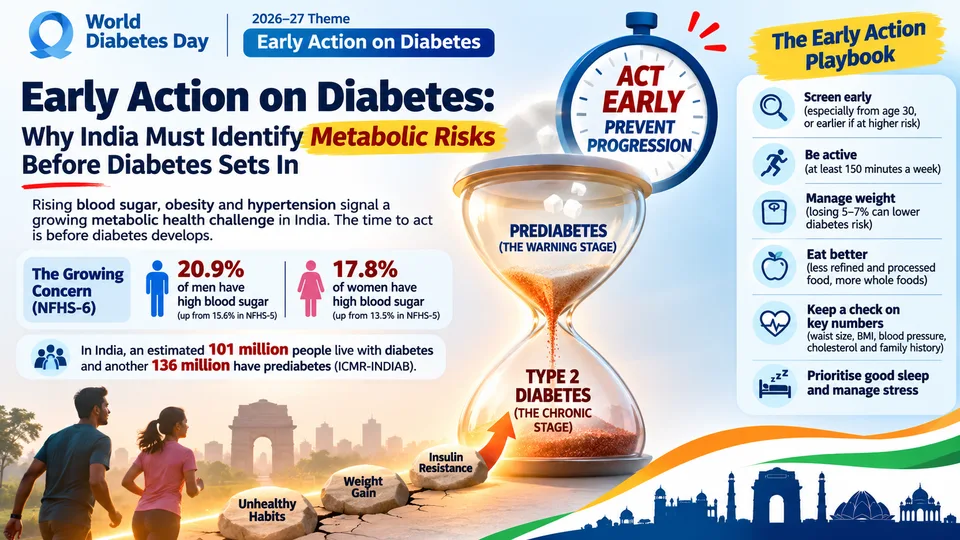
India’s growing diabetes burden calls for a shift in how the country approaches prevention and care. The NFHS-6 findings, released earlier this year, point to a worrying rise in elevated blood sugar, with nearly one in five men and a significant proportion of women showing high blood sugar levels or taking medication. The findings come alongside rising obesity and persistent hypertension, highlighting a wider metabolic health challenge.
The concern is not just the number of people already living with diabetes but the growing population at risk of developing it. Doctors say India needs to move beyond treating diabetes after diagnosis to identifying metabolic risks much earlier. That means strengthening routine screening, recognising prediabetes, addressing obesity and lifestyle-related risk factors, and making early intervention part of primary healthcare.
A warning signal across genders
For Dr Paras Agarwal, Director - Diabetes, Obesity and Metabolic Clinic, CK Birla Hospital, Gurgaon: — the numbers point to a deepening public health problem. “The NFHS-6 findings are concerning because they indicate that elevated blood sugar is becoming an increasingly significant public health challenge in India,” says Dr Agarwal. “The proportion of men with high or very high blood sugar, or those taking medication to control it, has increased from 15.6% in NFHS-5 to 20.9% in NFHS-6. Among women, the corresponding figure has risen from 13.5% to 17.8%.”
The rise cuts across groups. “This suggests that the burden of metabolic disorders is expanding across both genders and cannot be viewed as an issue restricted to older adults or urban populations,” he explains.
He also cautions against reading the figures as a direct count of diagnosed cases. “These figures should be interpreted as an important warning signal, rather than a direct measure of diagnosed diabetes, since the survey also includes people with elevated readings and those already on medication.”
Not just about blood sugar
What worries Dr Agarwal most is the link between rising blood sugar and other risk factors. “What makes this particularly worrying is the close association between rising blood sugar, obesity, physical inactivity, unhealthy dietary patterns and cardiovascular complications.”
That is why blood sugar alone is not enough to judge risk, says Dr Sadiq Mulla, Consultant Endocrinologist and Diabetologist, Inamdar Multispeciality Hospital, Pune. “Blood sugar is an important indicator, but it does not provide a complete picture of a person’s metabolic health. We also assess waist circumference, BMI, blood pressure and cholesterol levels to identify individuals who may be at risk of developing type 2 diabetes.”
NFHS-6 also shows rising obesity alongside a significant burden of hypertension. Dr Dheeraj Kapoor, Chief - Endocrinology, Artemis Hospital, Gurugram says the three conditions are closely connected.
“High blood pressure as well as diabetes and obesity are often associated with each other because of the common metabolic changes,” says Dr Kapoor. “Too much body fat, especially around the waist, can reduce your body’s sensitivity to insulin. This insulin resistance leads to high blood pressure as well as inflammation, unhealthy cholesterol levels and an increased risk of developing type 2 diabetes.”
The effects feed on each other. “As weight increases, the heart has to work harder and changes in blood vessel and kidney function can worsen hypertension. These conditions then worsen each other, increasing the risk of complications, kidney disease, heart attack and stroke.”
That is why treating one condition alone falls short. “This implies that the underlying risk might remain untouched if only one problem is tackled. Besides, proper monitoring and medication care should include weight management, balanced eating, regular activity, adequate sleep and reduced salt intake. Integrated approach to enhance metabolic health.”
Dr Agarwal makes the same point at the level of policy. “India needs to move beyond treating diabetes as an individual medical condition and recognise it as a growing population-level metabolic health challenge requiring sustained preventive intervention.”
Younger adults are at risk
Diabetes is increasingly being diagnosed at younger ages, and Dr Kapoor says changing habits are partly responsible. “Regularly eating packaged snacks, sugary drinks, refined carbs, and large portions may lead to weight gain and insulin resistance,” he says. “Work on a screen, limited outdoor activity, long hours of sitting and reliance on vehicles all contribute to the reduction of energy consumption.”
Stress and sleep play a part too. “Chronic stress, irregular sleep and late nights can also throw off hormones that regulate blood sugar and appetite, which can make it harder to make healthy decisions.”
Habits are only part of the picture, he adds. “Lifestyle is one factor, but family history and other risk factors also count.”
Diagnosis often comes late
Dr Agarwal says delayed identification remains a major gap in India’s diabetes response. “A substantial proportion of people develop metabolic abnormalities without experiencing obvious symptoms, allowing blood sugar levels to remain elevated for years before diagnosis,” he says.
The scale of the problem is large. “According to the ICMR-INDIAB study, India has an estimated 101 million people living with diabetes and another 136 million with prediabetes. This represents an enormous population at risk of developing diabetes and its associated complications. The challenge is that screening is often symptom-driven rather than preventive.”
What ‘early action’ means in practice
Early action begins before blood sugar reaches the diabetic range, says Dr Mulla.
“Early action means identifying people at risk of diabetes before their blood sugar levels reach the diabetic range and intervening at the right time,” says Dr Mulla. “Prediabetes, indicated by fasting blood sugar levels of 100–125 mg/dL, is an important warning sign that the body is struggling to regulate blood sugar effectively. Since most people with prediabetes do not experience noticeable symptoms, routine screening becomes essential.”
Lifestyle change is the first line of defence. “Timely intervention can significantly reduce the risk of developing type 2 diabetes. We recommend at least 150 minutes of moderate physical activity every week, such as brisk walking for 30 minutes, five days a week. For individuals who are overweight, losing even 5–7% of their body weight can substantially lower diabetes risk.”
The message, he stresses, is hopeful. “Prediabetes does not mean diabetes is inevitable. With consistent lifestyle changes and timely medical intervention, blood sugar levels can return to normal in many cases, helping prevent or delay type 2 diabetes.”
Dr Agarwal agrees that a prediabetes finding should prompt action. “Importantly, identifying prediabetes should trigger timely lifestyle interventions rather than simply waiting for diabetes to develop. Early detection can significantly improve long-term metabolic health outcomes.”
Who should be tested, and for what
Dr Agarwal’s prescription is routine screening. “India needs to strengthen routine metabolic screening, particularly among adults aged 30 and above, with earlier testing for individuals with obesity, a family history of diabetes, PCOS, hypertension or a sedentary lifestyle. Fasting blood glucose and HbA1c are useful screening tools, while an oral glucose tolerance test may be recommended in selected cases.”
Dr Mulla says waist size matters especially for Indians. “Waist circumference is particularly important in Indian adults because excess abdominal fat is strongly associated with insulin resistance. A waist measurement of 90 cm or more in men and 80 cm or more in women is considered a warning sign.”
BMI can mislead. “BMI also helps assess weight-related risk, although individuals can develop metabolic problems even when their BMI appears normal. Blood pressure and cholesterol levels provide additional clues. High triglycerides and low HDL (good cholesterol) are frequently associated with insulin resistance and can indicate metabolic problems even before diabetes develops.”
Family history and other conditions call for closer watch. “People whose parents or siblings have type 2 diabetes should consider earlier and regular screening. Women with a history of gestational diabetes or PCOS, and individuals with fatty liver disease, hypertension, obesity or abnormal cholesterol levels, also require closer monitoring.”
Dr Kapoor says none of this should wait for middle age. “Screening should not wait until middle age. Adults with a family history of diabetes, high blood pressure, excess waist fat, past gestational diabetes or who are overweight should talk to a clinician about early testing. Early detection creates an opportunity to prevent or delay complications with timely lifestyle and care changes.”