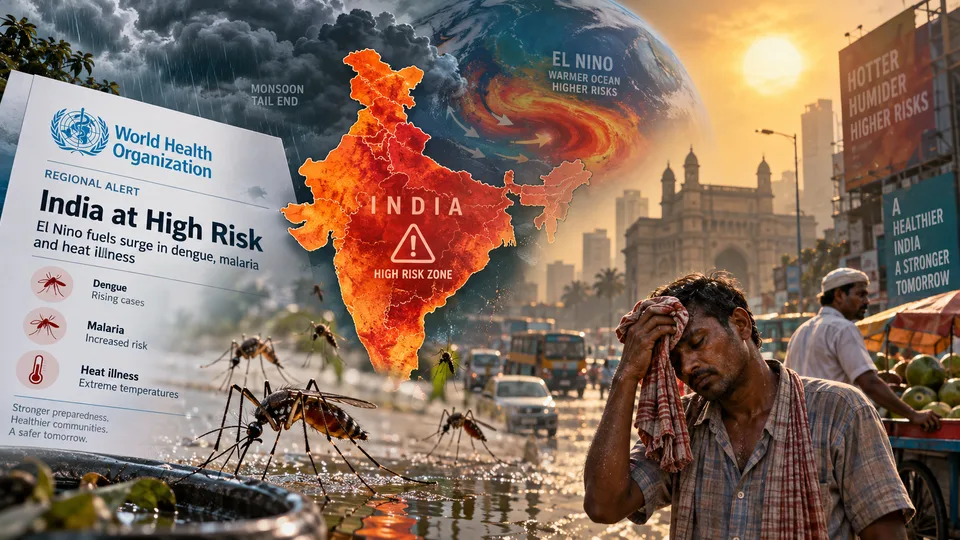
The World Health Organisation has issued a serious warning for India, categorising the country as “high to very high” risk as an intensifying El Nino pattern combines with unstable monsoon weather to create a two-pronged health emergency.
According to the WHO’s latest Global Public Health Situation Analysis, unusual rainfall and elevated temperatures across South Asia are expected to drive up both vector-borne infections and heat-related illness through the August-to-October window.
Public health experts explain that rising temperatures don’t just make conditions warmer — they actively speed up mosquito breeding cycles and shorten the time viruses need to become transmissible once inside a mosquito, meaning even modest temperature increases can sharply accelerate outbreak potential in dense urban areas.
The heat itself poses a separate risk, particularly for outdoor workers, street vendors, and people managing chronic heart, lung, or kidney conditions, who face greater danger of dehydration, exhaustion, and organ strain. Pregnant women and infants are considered especially at risk, since heat exposure has been associated with preterm birth and complications in newborns, whose bodies struggle to regulate temperature effectively.
The WHO report additionally points to border areas near Nepal and Bhutan, where flooding and seasonal population movement raise the chances of waterborne diseases spreading.
With disease patterns becoming harder to predict along traditional seasonal lines, the WHO has urged Indian hospitals and health workers to boost monitoring, secure medical supplies, and remain alert for unusual disease symptoms in the coming months.