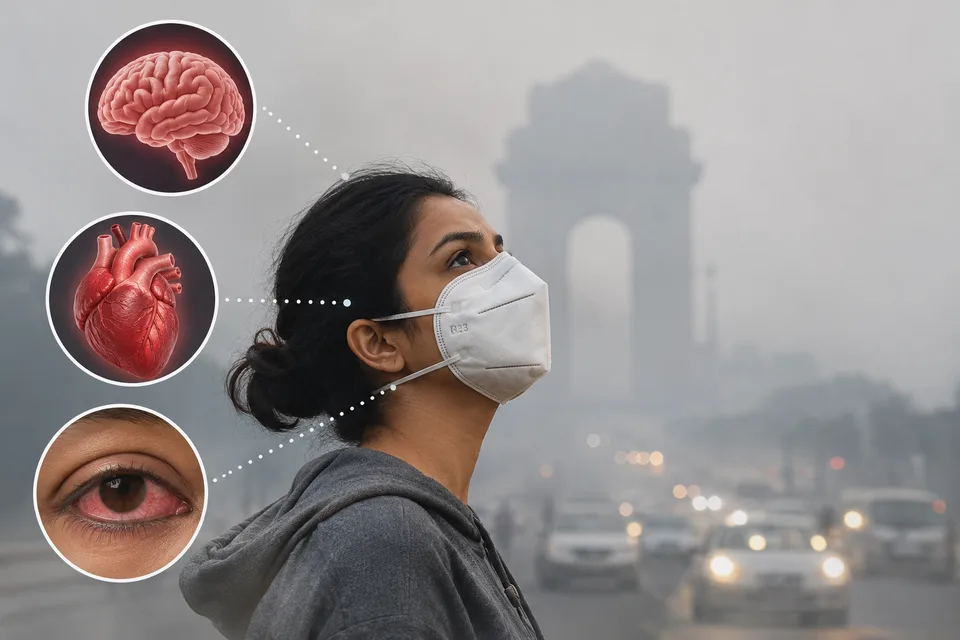
Air pollution is no longer just a respiratory concern. As air quality worsens through the winter months, a growing body of research links prolonged exposure to fine particles such as PM2.5 and PM10 with heart disease, neurological problems and chronic inflammation. Children, older adults and people with chronic conditions are most at risk. Health Aaj Kal spoke to specialists across disciplines to understand what pollution does to different organs, and how people can protect themselves.
It does not stop at the lungs
“Pollution does not stop at the lungs. Fine particles enter the bloodstream and reach almost every system,” says Dr Bibhu Anand, medicine expert at Sir Ganga Ram Hospital. Beyond the heart and brain, he points to chronically dry and irritated eyes, skin that ages faster and flares up with eczema or acne, and links to fatty liver and insulin resistance. Hormones, fertility, pregnancy outcomes and immunity can also be affected.
“The common thread is persistent low-grade inflammation and oxidative stress,” Dr Bibhu Anand explains. In people with diabetes, cells respond poorly to insulin, making sugar control harder. In hypertension, blood vessels stiffen and pressure rises. “Patients with existing conditions are essentially starting with less reserve, so the same smoggy week hits them harder.”
The heart under pressure
The cardiovascular damage is among the best documented. Dr Vijay D’Silva, Medical Director at White Lotus International Hospital and Clinical Advisor & Mentor at Heartnet India, says PM2.5 penetrates deep into the lungs, causing inflammation and oxidative stress, while certain particles and chemical constituents also circulate in the blood. “The effects of air pollution are not restricted to the lungs. The lining of arteries can be damaged; vessels can narrow, blood pressure rises, and platelets can become more ‘sticky’, increasing the risk of blood clots,” he says. Over time this feeds atherosclerosis and can make existing plaques unstable, triggering a heart attack, while short-term spikes can disturb heart rhythm in vulnerable people.
The scale is considerable. The World Health Organization estimates that outdoor air pollution caused an excess of 4.2 million deaths globally in 2019. A 2020 scientific statement from the American Heart Association links even a temporary rise in PM2.5 to a higher risk of heart attack, stroke, heart failure and abnormal heart rhythm, with risk climbing the longer the exposure lasts. That holds for people with no known heart disease too. “No prior condition doesn’t mean no risk,” says Dr Vijay D’Silva.
For those who already have heart disease, he advises cutting back on activity during pollution episodes rather than stopping altogether. Vigorous activity and chores should move indoors when the AQI crosses 150, windows should stay shut, and exertion near busy roads should be avoided. Masks matter, but only the right kind. “A well-fitting N95/FFP2 mask will greatly reduce your intake of PM2.5, while a cloth mask has minimal filtering capacity for PM2.5,” he says. Patients should never change their medicines on their own: “Do not change your medications or dosage without your physician’s approval.” Chest pressure, unexplained breathlessness, fainting or a persistent racing heart need immediate attention.
A threat to the brain
The brain is not spared either. Dr Vivek Barun, Associate Chief and Head of Epilepsy at Artemis Hospitals Gurugram says, “The tiniest particles can travel through the lungs into the bloodstream, triggering inflammation throughout the body.” The nervous system may also be reached through pathways from the nose. This can cause oxidative stress, damage cells and affect the blood-brain barrier that shields the brain from harmful substances, and chronic inflammation may disrupt communication between nerve cells over time.
Long-term exposure has been tied to a higher risk of stroke, memory problems, and faster cognitive decline, and studies have found connections to Parkinson’s and Alzheimer’s disease. Dr Vivek Barun is careful about what this does and does not mean. “Pollution is one risk factor that leads to the development of these conditions but has not been shown to be a direct cause,” he says.
Children are especially vulnerable. “Children’s brains and nervous systems are still developing, making them especially vulnerable,” says Dr Vivek Barun, adding that exposure may affect attention, memory, learning and behaviour. Older adults are at greater risk because their brains may be less able to withstand oxidative stress and inflammation, and people with epilepsy, Parkinson’s, dementia or stroke may see symptoms worsen. Families should watch for unusual forgetfulness, difficulty concentrating, confusion, poor sleep, behavioural changes and reduced coordination. Protection starts with monitoring the AQI, limiting outdoor activity on high-pollution days, using HEPA purifiers, wearing a well-fitted N95 when exposure is unavoidable and keeping indoor smoke out. Regular physical activity, adequate sleep and a healthy diet also support brain health.
Eyes in the firing line
The eyes are exposed to the air all day, which makes them an easy target. “Smog and other air pollution settle directly on the eye, which stays exposed to the surrounding air,” says Dr Vishal Arora, Head of Ophthalmology at Artemis Hospital Gurugram. Fine particles, dust, smoke and gases collect on the surface and disturb the tear film that keeps the eye moist and protected. The result is dryness, burning, itching, redness, heavy watering and a gritty sensation. Pollutants can also trigger allergic conjunctivitis, and prolonged exposure may worsen existing dry eye disease. Contact lens wearers often feel more discomfort because pollutants gather around the lens.
On high-pollution days, Dr Vishal Arora suggests avoiding unnecessary time outdoors and wearing well-fitting glasses or sunglasses to limit the particles reaching the eyes. “Lubricating eye drops, particularly preservative-free artificial tears, can help wash out irritants and replenish moisture,” he says. A HEPA purifier helps indoors. He also cautions, “Do not rub your eyes, as this may increase inflammation.” If irritation sets in, wash hands properly and pause contact lens use for a while. “If redness, itching, pain or excessive watering continue despite these precautions, consult an ophthalmologist,” says Dr Vishal Arora. Severe pain, discharge, sensitivity to light or blurred vision should be evaluated immediately.
Small habits, a smarter diet
Doctors stress that everyday habits help, but they are a support, not a shield. Dr Bibhu Anand’s advice is simple: “Eat antioxidant-rich foods, stay hydrated, and don’t skip your regular medicines.” Dr Vijay D’Silva says a low-salt diet that emphasises vegetables, fruits, pulses and whole grains can help control blood pressure and cholesterol, but is blunt about its limits: “no meal or supplement can neutralise pollution.”
Winter is also a good time for check-ups, says Dr Bihbu Anand, who suggests lung function tests, blood pressure and sugar monitoring, and a yearly flu shot. A cough that lingers beyond two weeks should not be ignored, and breathlessness, chest tightness or unusual fatigue are reasons to see a doctor early.