Many of India’s city-based professionals may be carrying health problems they have not noticed yet. The Workforce Health Index 2026, published by group health insurance provider Loop Health, suggests that risks usually linked to later life are appearing in people’s thirties, often before any symptoms.
This is the report’s second edition and a much larger one. It draws on more than 8.16 lakh lab values from roughly 11,400 health reports, about 9,000 survey responses and around 74,000 hospital claims.\
The claims data is new this year. The 2025 edition rested on about 3,400 survey responses. The datasets are separate and not linked at the individual level, and the company says the findings describe its own tested, surveyed and insured groups rather than the whole country.
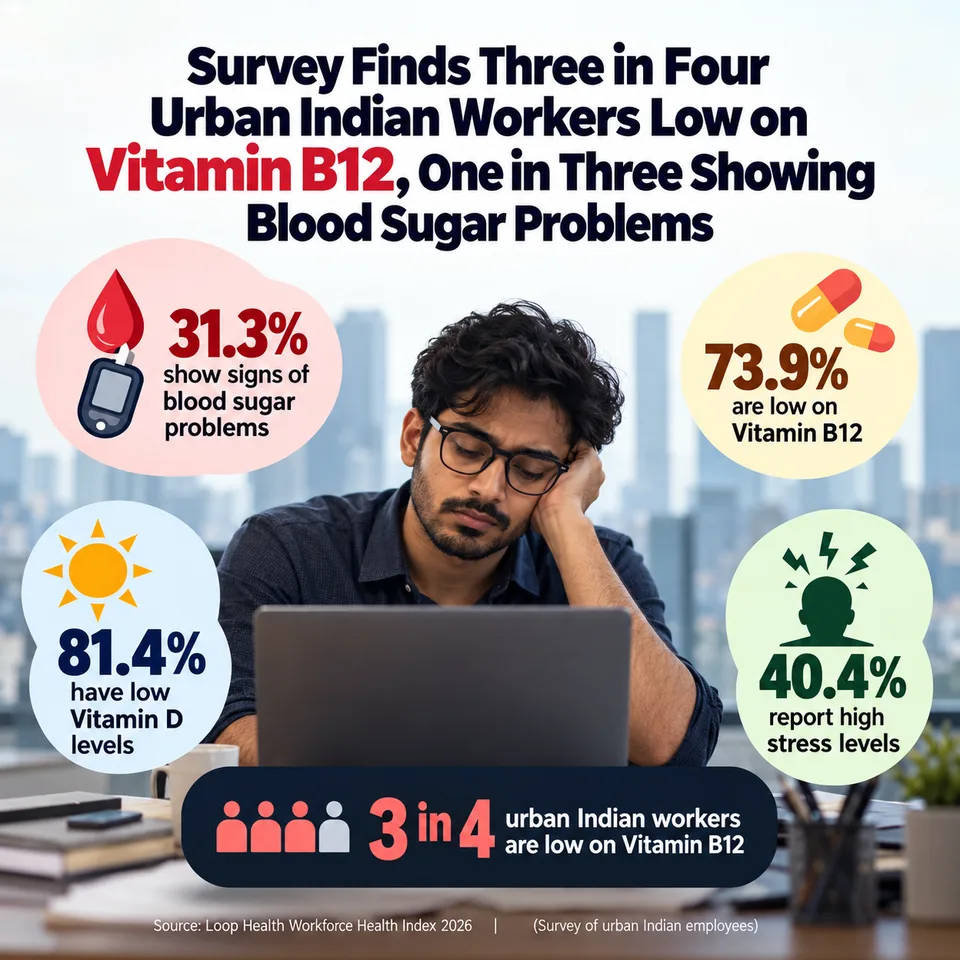
Blood sugar is the most worrying finding. Glucose dysfunction was recorded in 31.3% of employees tested, and among more than 7,000 HbA1c reports, 38.7% fell in the prediabetes or diabetes range.
Nutrition gaps are just as widespread. About 81.4% of vitamin D reports fell below the sufficiency mark, and 60.1% were deficient or severely deficient. Low vitamin B12 appeared in 73.9% of reports. Vitamin D supplementation has also slipped, from 26.2% last year to 20.4%.
Anaemia shows a gender and city divide. Among women, 34.6% of reports had haemoglobin below 12 g/dL, compared with 8.9% of men below 13 g/dL. In Mumbai, 52.3% of women’s reports fell below the threshold compared with 23.2% in Bengaluru.
Stress is also high. Of more than 7,300 respondents, 40.4% rated their previous week at seven or above on a ten-point scale.
The data also shows who seeks care and who doesn’t. Family members and other dependents account for 66.5% of claims, while employees account for 33.5%. Preventive testing tracks income closely: 15.6% of respondents earning under Rs 3 lakh a year opted for a full-body check-up, against 54.3% of those earning Rs 40 lakh or more.
How people find health information is changing too. While 54% turn to doctors, 19.8% use AI tools such as ChatGPT, roughly level with the 19.7% who rely on Google.
Singh said there is a clear gap between the risks people carry and the care they seek, and that prevention begins with knowing what is happening in the body and acting early.
The survey covers Mumbai, Delhi-NCR, Bengaluru, Hyderabad and Pune.