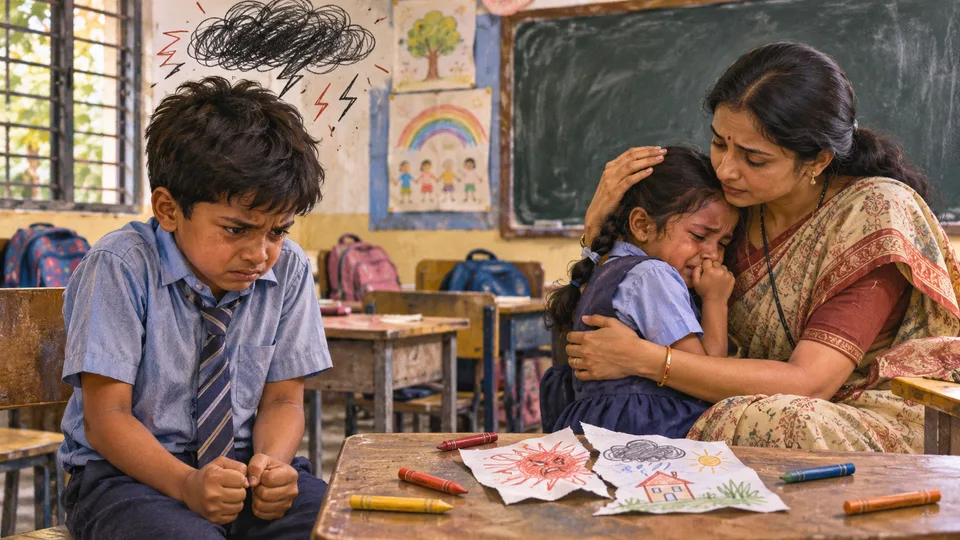
A six-year-old girl was seriously injured after an eight-year-old boy allegedly assaulted her inside a Panchkula classroom, in an incident that has left parents and educators shaken. According to reports, the boy allegedly banged the girl’s head against a desk, kicking her and hitting her with a brick. It is being said that the girl had called the boy “crazy”, which angered him. Psychologists say violence of this intensity in a young child is rarely sudden. It usually signals unmet emotional needs, exposure to aggression or a lack of guidance, and calls for understanding and intervention rather than punishment alone.
“A child of this age does not fully grasp that harm can be permanent,” said Neelam Mishra, Consultant Psychologist, Sir Ganga Ram Hospital. “When aggression of this intensity appears, the first thing to ask is what the child has seen and absorbed. Violence at home, harsh discipline, and unmonitored exposure to aggressive content or bullying he may have faced himself can all shape behaviour. The act is grave, but the response must be to understand the child, not merely condemn him.”
The reported trigger, psychologists say, shows how little it takes when a child has not learned to handle hurt. Name-calling is common among young children. “Insults are routine at this age,” Neelam Mishra said. “A reaction this extreme tells us the child had no tools for managing anger. The remark did not cause this. It exposed what was already missing.”
Screens are a recurring concern. Games and videos that show violence without consequences can blur the line between play and real harm, especially when parents do not monitor what children watch.
At eight, impulse control, empathy, and the understanding of consequences are still developing.
Poornima Gupta, a contemplative psychologist and expressive art therapist at BLK-Max Super Speciality Hospital, said emotional regulation is a skill children must be taught. “Children learn to manage anger by watching adults manage it. Anger triggers physiological changes in the body. Blood flows to the hands, making it easier to grasp a weapon or strike a foe; heart rate increases, and a rush of hormones such as adrenaline generates a pulse of energy strong enough for vigorous action. If a child has never been shown how to name frustration, walk away, or ask for help, anger can come out physically and explosively. The warning signs, such as frequent fights, cruelty towards others, or extreme tantrums, are often dismissed as a phase,” she said.
For young children who cannot yet put big feelings into words, Poornima Gupta said, expression through art can serve as an outlet. “Children at this age often don’t have the vocabulary for anger, hurt, or shame, so it stays in the body and comes out as action,” she said. “Drawing, colouring, clay, or storytelling gives those feelings somewhere to go before they build up. Simple contemplative practices help too. A few slow breaths, a pause before reacting, and learning to notice ‘I feel hot and tight inside’ are skills even a six- or eight-year-old can pick up, and schools and families can build them into the day.”
What the case should prompt
Experts say the incident points to gaps that no single school or family can close alone.
For schools, Neelam Mishra said emotional well-being deserves the same seriousness as physical safety. “Every school should have a trained counsellor, or at least a designated staff member who knows how to spot and respond to early signs of aggression,” she said. “Teachers should be trained to handle such children without shaming them. CCTV shows what happened after the fact. Prevention happens through relationships with children.”
Supervision matters too, she added, since young children should not be left unattended for long stretches.
For authorities, she said the case argues for making counselling support and teacher training on child behaviour a requirement rather than an option. “An assessment after an incident should lead to sustained therapeutic support for the child, not a one-time evaluation,” Neelam Mishra said. “Support is also needed for the injured child and for classmates who witnessed it.”
For parents, the message is to act early. “Aggression in a young child should be addressed as soon as it appears, not hidden out of fear of judgement,” Neelam Mishra said. She advised limiting violent content, spending unhurried time with children, and teaching them words for feelings. Parents of children who show aggression are urged to consult a child psychologist rather than wait.
The recovery ahead extends beyond the girl. Experts say children who experience or witness such violence can develop anxiety, nightmares, and a fear of school. Parents are advised to talk calmly with children about what happened, avoid graphic details, and watch for changes in sleep, appetite, or mood.
Whatever the assessment and investigation find, mental health professionals say the case should prompt a wider look at how adults, at home and in school, teach children to handle anger.